Mundane: A Delicate Modern Calligraphy Font for Handmade Brands
If you've ever spent hours tweaking letter spacing on a candle label only to find it still feels "off," or struggled to balance elegance and legibility on a wedding welcome sign, you know how much the right script font can quietly elevate your entire product line. Mundane is that rare modern calligraphy font — soft, intentional, and deeply human — designed not just to look beautiful, but to work beautifully across physical and digital handmade goods.
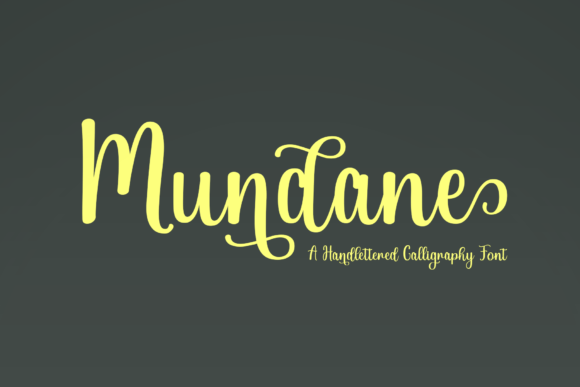
What makes Mundane stand out in the Script Amp category isn’t flashiness — it’s authenticity. Its curves flow with gentle momentum, its lines taper naturally like ink pulled from a flexible nib, and its rhythm feels handwritten without sacrificing clarity. With 289 characters, it includes standard Latin letters, numerals, punctuation, and essential accented characters — enough to confidently handle boutique tags, bilingual greeting cards, or seasonal packaging for small-batch makers. It’s not a sprawling superfamily, but a focused, purpose-built typeface built for crafters who value restraint and refinement.
I use Mundane most often where first impressions matter: product labels, gift tags, and invitation suites. Its delicate weight reads cleanly at 10–12 pt on matte sticker paper, and scales gracefully up to 36 pt for framed wall art or farmhouse-style wooden signs. Because the strokes avoid extreme contrast or aggressive flourishes, it cuts reliably on Cricut and Silhouette machines — no broken terminals or fragile joins to snag during weeding. On small 1.5" round stickers for tea tins or soap bars, I’ve found it remains legible even when set in all caps with modest tracking. That’s rare for a script font, and invaluable when your customers are reading under dim boutique lighting or scrolling quickly through an Etsy listing.
For wedding stationery, Mundane brings warmth without cliché. It pairs effortlessly with clean sans serifs like Montserrat or Inter for body text — letting the script shine as a name, date, or “welcome” header while keeping RSVP details crisp and scannable. I recently used it for a set of printable seating charts and menu cards; guests consistently commented on how “inviting” and “thoughtful” the typography felt — a subtle signal of care that translates directly into perceived brand quality.
It also works beautifully in unexpected places: heat-pressed onto cotton tote bags (its smooth curves hold up well under medium-pressure transfers), embossed onto kraft paper gift tags, or layered behind watercolor textures in digital printables. Because its baseline is steady and its x-height generous, it avoids the “wobbly” effect some expressive scripts develop when scaled down or placed over busy backgrounds. For holiday product packaging — think cinnamon roll kits or handmade ornament boxes — Mundane adds festive charm without veering into kitsch.
Readability matters most where function meets form. Mundane excels in short-form display use: shop names, product titles (“Honey Lavender Soap”), quote art, and social media graphics. It’s not intended for long paragraphs — and honestly, neither are most script fonts meant for commercial craft use. That’s okay. Its strength lies in moments of emphasis: the name on a baby onesie, the flavor name on a jam jar, the headline on a planner cover. When paired intentionally — say, Mundane for a logo lockup and a friendly, open sans serif for supporting text — it builds instant brand consistency across stickers, web banners, and packaging.
Font pairing is intuitive here. Try it with a warm, low-contrast sans serif (like Poppins or Lato) for balance and versatility. Avoid overly geometric or ultra-thin companions — they clash with Mundane’s organic pulse. If you’re designing SVG files for cutting machines, test the lowercase “a”, “g”, and “y” in your software preview: Mundane’s alternate glyphs and subtle ligatures are included, giving you flexibility without requiring manual kerning fixes.
File formats matter in real-world production. Mundane comes in OTF and TTF — both fully compatible with Canva, Adobe Creative Cloud, Cricut Design Space, and Silhouette Studio. No need for workarounds or tracing. And because it’s a premium font licensed for commercial use, you’re covered whether you’re selling physical mugs with Mundane-printed quotes, bundling editable Canva templates, or licensing SVG files for others to cut and sell. Just keep your license active — it’s one less thing to audit when scaling your shop.
What I appreciate most is how Mundane supports intentionality. It doesn’t shout. It invites. That makes it ideal for slow-made brands — herbal apothecaries, ceramic studios, letterpress printers — where craftsmanship and quiet confidence are part of the story. A customer holding a card printed in Mundane doesn’t just see words; they feel attention. They sense care in the curve of a “c”, the pause before a comma, the way the “t” crosses with quiet precision.
Whether you're hand-lettering digitally or prepping files for print-on-demand, Mundane fits seamlessly into your workflow — no over-engineering required. It’s the kind of font that disappears into your design, leaving only resonance behind. Not every project needs drama. Sometimes, what your handmade brand truly needs is something softly certain, elegantly grounded, and quietly unforgettable. That’s Mundane.